Are you feeling overwhelmed about packing for an upcoming trip to Europe? Don’t worry, I’ve done the research for you and compiled this thorough list of must-pack travel essentials for Europe that you’ll actually use!
As you prepare for your trip to Europe, consider exploring our European travel content for more insights. We have articles about Cyprus, Denmark, France, Ireland, Italy, the Netherlands, Switzerland, Türkiye, and the United Kingdom.
Disclosure: This guide to packing for Europe contains affiliate links. As an Amazon Associate, I earn from qualifying purchases. When you click on an Amazon or other affiliate partner link and make a purchase, I may earn a commission.
Wondering What to Pack for Europe?
Perhaps you’re reading this Europe packing guide because it’s your first time visiting Europe, and you’re wondering what to bring on your trip. Or maybe it’s been a while since your last European vacation, and you want to make sure you don’t forget any essentials. I get it. Packing for Europe can feel like a daunting task — even for a seasoned traveler like myself.
Over the past 25 years, I’ve traveled to Europe in every season, visiting different destinations for varying lengths of stay. I’ve sweated through sweltering summer days in Spain, bundled up during the winter in Germany, and outfitted myself with rain gear for blustery and wet days along Ireland’s western coast. I’ve lugged heavy suitcases during a week-long family summer vacation in Switzerland, but I’ve also packed light, using only a carry-on bag and a small backpack for a two-week fall trip around Ireland.
Through trial and error, I’ve learned from my packing mistakes for Europe trips. As I recently prepared my own Europe packing list for my ninth trip to the continent, I’m sharing my favorite essentials with you. I hope these travel gadgets, gear, and clothing items will make your trip to Europe less stressful and more enjoyable. So, sit back, relax, and discover what to pack like a pro before your next European travel adventure!
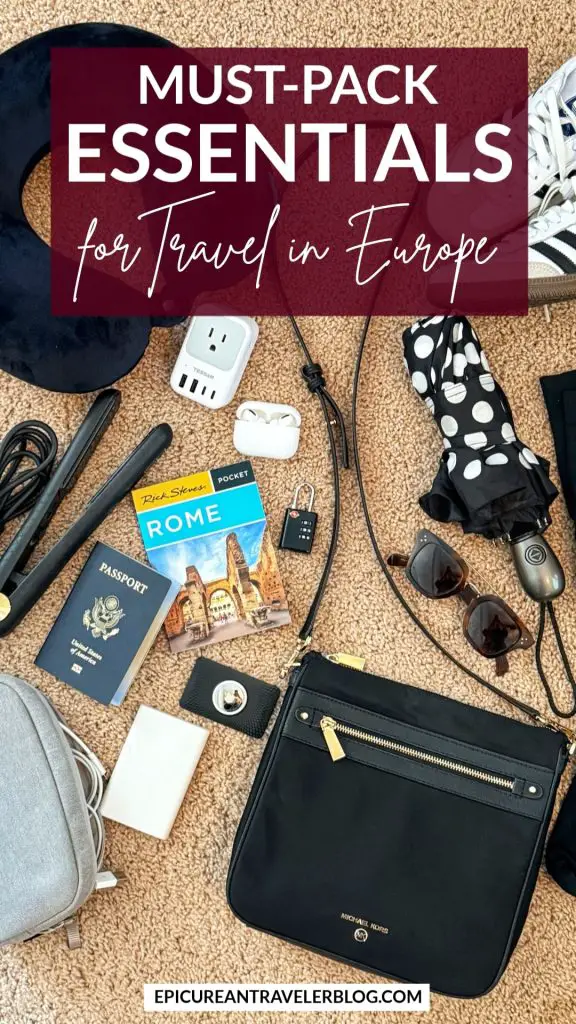
Save this Europe packing tips pin to your ‘Europe Travel’ Pinterest board now!
Travel Neck Pillow
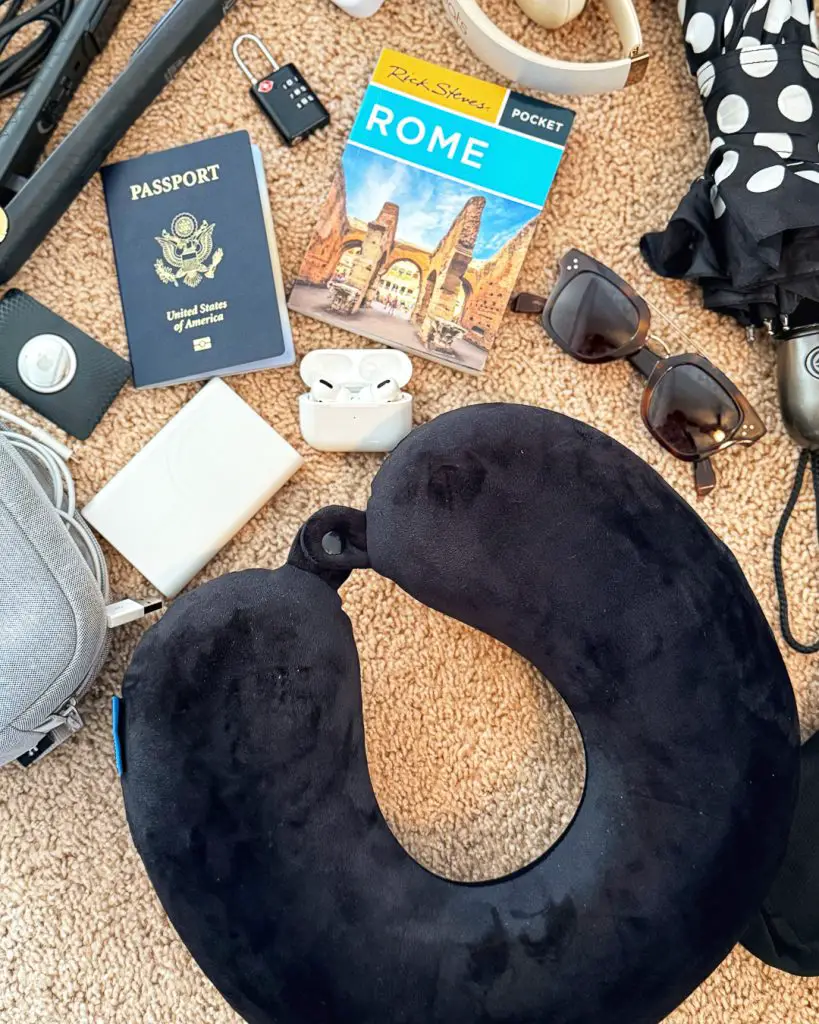
When flying to Europe from North America, you’ll want to get quality shut-eye during your overnight flight to arrive rested and ready to explore your European destination. That is why I recommend investing in a travel neck pillow.
When purchasing a travel pillow, choose one that is easily portable, machine washable, and provides sufficient support to keep your head elevated without being too firm or too soft for your preference.
Although an inflatable pillow may seem like a space-saver, I don’t recommend them because they are prone to leaks. Pillows that attach to your bag or that can be compressed into a travel bag would be better options.
Before my trip to Milan last year, I stopped by the Brookstone shop at Detroit Metropolitan Airport and purchased this travel neck pillow. The soft fleece material was so cozy, and I felt like my neck was well supported by the memory foam as I dozed off somewhere over the Atlantic.
If you are more of a chin dipper or a forward nodder when sleeping on a plane, the BCOZZY travel neck pillow that fully wraps around your neck may be a better option for your sleep style.
Wireless Noise-Canceling Headphones
Another travel essential that makes overnight flights to Europe more comfortable is a set of noise-canceling headphones.
Of course, you can use your headphones or earbuds to listen to music, podcasts, or audiobooks, or to pass the time watching TV shows or movies on your Bluetooth-paired device. But I also recommend packing noise-canceling headphones or earbuds to protect your hearing.
Between the plane’s roaring engines, chatty passengers, and crying infants, there is a lot of noise potentially interfering with your sleep. Thankfully, a set of noise-canceling headphones reduces that background noise.
As an Apple user, I’m partial to the in-ear Apple AirPods Pro because they are so compact for travel and compatible with my devices. If you prefer over-ear wireless headphones, the Beats Studio Pro offers 40 hours of battery life and compatibility with Apple and Android devices.
Compression Socks
The third essential I recommend for travel to Europe won’t necessarily make your overnight flight more comfortable, but compression socks may help combat potential physical side effects from flying.
Some benefits of wearing compression socks on long-haul flights may include preventing swelling in your legs and feet, reducing the risk of blood clots, and improving circulation.*
After hearing horror stories from fellow travel enthusiasts whose ankles had swollen to the point of pain after overnight flights between the US and Europe, I purchased these plus-size compression socks and wore them on my long-haul flight from Detroit to Istanbul.
I opted for solid black knee-high socks that blended in with the leggings I wore on my flights, but you’ll find compression socks in varying lengths, compression levels, colors, and patterns. These ombre-print knee-high compression socks are a fun and bold choice for travelers who prefer bright colors.
When ordering compression socks, it’s essential to refer to the sizing guide and measure your calf accurately to ensure you’re wearing the correct size. Unfortunately, ill-fitting socks will not only be uncomfortable to wear but may also fail to deliver the desired benefits.
*Please note: I’m not a medical professional, and this is not medical advice. It is best to consult your doctor about using compression socks before flying to Europe.
Cozy Outfits for Travel Days & Hotel Lounging
Since Europeans don’t typically wear athleisure clothing outside hiking or exercise, I try to avoid it to better blend in with the locals. However, I make an exception for flying and when I’m in my hotel room.
On an overnight flight to Europe, you’ll want to be as comfortable as possible — without wearing actual pajamas. Luckily, there are many cozy athleisure options these days.
High-quality leggings and joggers designed for exercise are made from lightweight, quick-drying, moisture-wicking materials, making them ideal for travel as well.
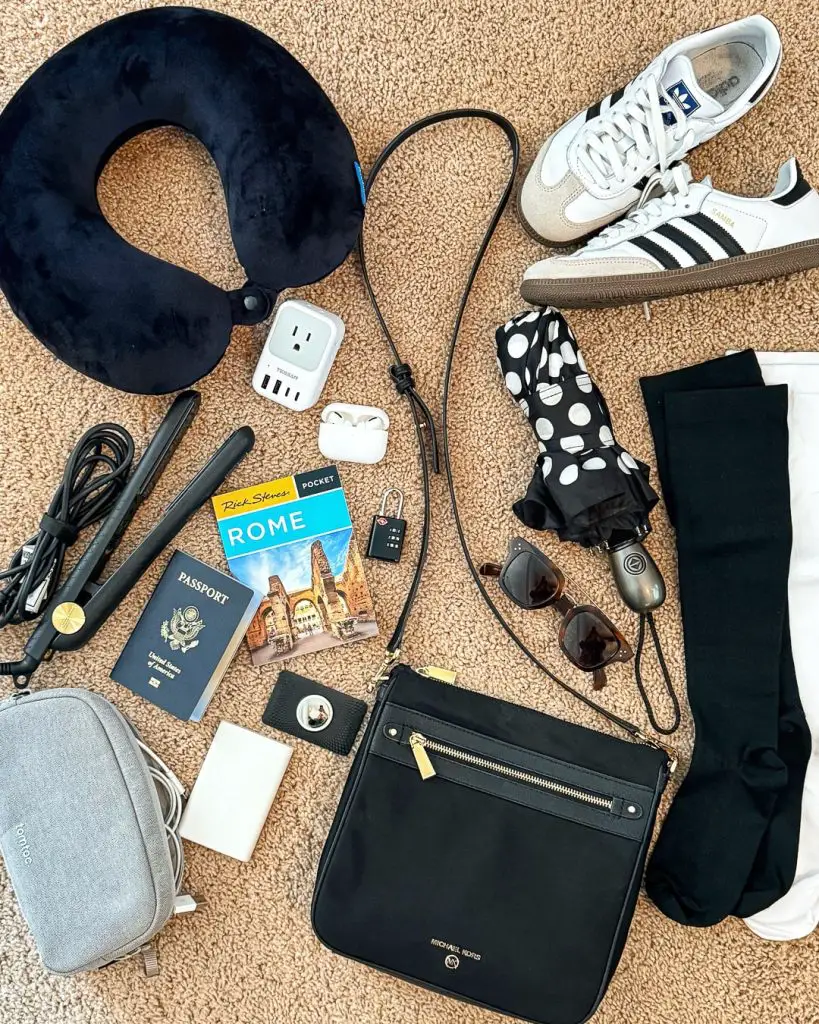
That is why I prefer workout leggings or joggers paired with a basic T-shirt and a sweatshirt, such as the Gap VintageSoft Hoodie, for long travel days. Though not the most polished outfit, this combination offers functionality and comfort.
During my recent flight to Rome, I wore these lightweight Athleta high-rise joggers, and on the flight home, I wore these buttery-soft Nike leggings with handy side pockets.
TSA-Approved Luggage Locks
Now that we’ve discussed some essentials for long-haul flights to Europe, I’ll share the safety and security essentials I use and recommend for traveling in Europe.
First and foremost, I use TSA-approved luggage locks to secure my bags, preventing pickpocketing in crowded spaces like airports, train stations, and public transportation.
Although many suitcases come with built-in locks, luggage locks are handy for securing zippers on your personal item, such as a purse or backpack, that you plan to stow in the plane’s overhead compartment or at your feet.

AirTags & Tile Mate Item Locators
Another security measure I take when traveling to Europe is placing AirTags in my checked luggage, carry-on bag, and purse. For families, couples, and anyone who typically travels with more than one bag, the four-pack is a worthwhile investment.
You simply place your AirTag in your luggage before you leave home, and it tracks your bag’s location throughout your trip. You’ll receive notifications on your Apple device’s Find My app when your bag has been left behind.
For your own safety, I don’t recommend chasing your bag’s snatcher a la The Summer I Turned Pretty’s Belly in Paris. However, if your airline misplaces your luggage en route to Europe, you should share your AirTag’s location with your airline to find your lost suitcase.
For travelers who don’t own an Apple device, Tile offers a variety of Android-compatible Bluetooth trackers; however, the Tile Mate’s location tracking is not as accurate as that of the AirTag.
VPN
A VPN, or Virtual Private Network, protects your online privacy and security while traveling in Europe. As you can imagine, this is especially important when connecting your device to public Wi-Fi networks, such as those at airports and in hotel lobbies.
Using a VPN while in Europe is also beneficial because you can access geo-restricted websites, apps, streaming services, and, most importantly, your bank’s website.
One of the best VPNs for traveling in Europe is NordVPN, which has virtual servers in over 120 countries, including more than 50 in Europe. It also has an easy-to-use interface, built-in antivirus tools, and excellent speed ratings. I recommend starting with the One-Month Plus plan and adjusting as needed.
Tech Organizer Travel Case
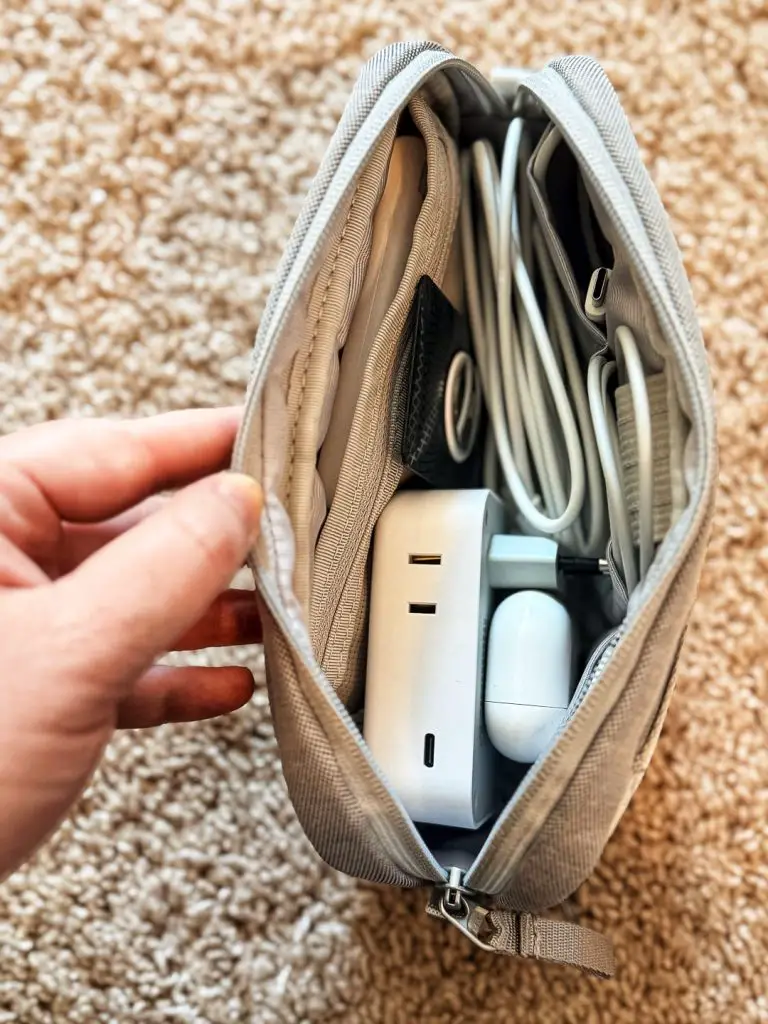
With our phones, smartwatches, and digital cameras, we travel with so many electronics and their various charging cords and plugs these days. To keep track of them all when I’m traveling to Europe, I pack my power bank, plug adapter, and various chargers in this electronics organizer travel case.
Gone are the days of tangled cords or rummaging around your purse. Cords can be wrapped and tucked into the interior side pockets. A slim power bank or mobile phone fits into the opposite side pocket, and bulkier items, such as a plug adapter and earbud cases, tuck neatly into the middle section.
The case is small enough to fit into the plane’s seatback pocket for easy access to mobile devices and chargers during your flight. It also conveniently keeps electronics together for a smooth security checkpoint experience.
eSIM
This Europe travel essential is not necessary if, like me, you have international coverage from your wireless carrier, but it is extremely beneficial if you don’t. You’ll avoid costly roaming fees and can use travel apps without being connected to Wi-Fi.
With an unlocked iPhone XS or newer model, you can use the Dual SIM feature with an eSIM to connect to local networks in Europe while keeping your primary carrier’s plan at home.
During our trip to Milan, my husband purchased an Airalo eSIM, allowing him to connect to a local network in Italy.
You don’t need to wait until you are in Europe to set up your eSIM, though. I recommend purchasing your eSIM and installing it before your trip. Then, you can connect to a local mobile network upon arrival.
Portable Power Bank
Also, when I’m on a trip in Europe, I’m constantly using my mobile phone for messaging, scanning mobile tickets, booking activities and restaurants on the fly, navigating directions, capturing photos and videos, and posting to my social media accounts.
All of that drains the battery’s juice, so my phone typically needs a boost to get through a full day of sightseeing. That is why I always travel with one or two portable power banks.
I like the budget-friendly Miady portable chargers because of their slim design, which fits perfectly in a purse or coat pocket. They also offer multiple outlets for charging devices such as phones and watches.
One downside is that Miady power banks don’t have attached cords, so you’ll need to remember to pack yours. Also, keep in mind that portable chargers are not allowed in your checked bags when flying, so pack them in your carry-on bag before your flight.
European Travel Plug Adapter
When visiting Europe from North America, you’ll need a plug adapter to charge your mobile phone and other electronics.
Plugs in most European countries are the two-pronged Type C and the three-pronged Types E and F. The Type C plug is the most versatile for European travel because it is compatible with Types C, E, and F sockets, whereas Types E and F plugs are not compatible with Type C sockets.
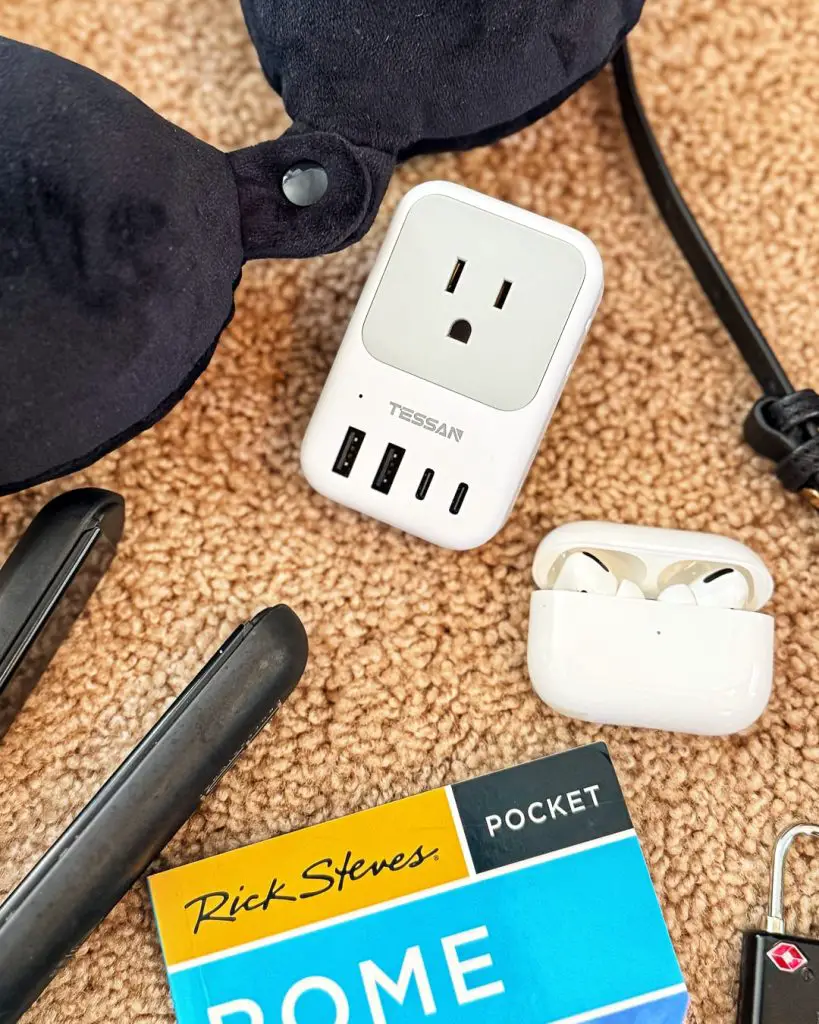
Therefore, for travel within continental Europe, I recommend this European travel adapter. It has four charging ports: two USB-A and two USB-C. With this adapter, you only need to pack your charging cords and can leave bulky wall plugs at home. This is ideal if you are only traveling with a mobile phone, a watch, headphones, a power bank, and/or a tablet.
If you are traveling with a laptop, cameras with external battery packs, or other larger electronics, this European Type C plug adapter offers additional versatility for charging multiple devices. It features two USB-A and three USB-C ports, in addition to three Type A outlets and one Type B outlet for three-pronged plugs.
However, if you are traveling to Cyprus, Malta, Ireland, or the UK, you’ll need a travel plug adapter for the Type G socket.
For frequent international travelers or those requiring Type C and Type G plug adapters for an upcoming trip to Europe, I recommend investing in a world travel adapter kit. It comes with interchangeable plug adapters for the UK, continental Europe, and many other global destinations. Plus, it can simultaneously charge seven devices via various plug outlets and USB ports, and it features built-in surge protection.
It’s important to note that adapters don’t convert voltage. Voltage in Europe ranges from 220 to 240 volts, whereas in North America it ranges from 110 to 120 volts. Since most modern small electronics and chargers for phones and laptops have inputs that range from 110 to 240 volts, you likely don’t need a voltage converter for your trip to Europe. However, if you are traveling with single-voltage electronics, this is the voltage converter that I use for international travel.
Dual-Voltage Hair Styling Tool
We’ve discussed some of the electronics you might bring to Europe, but hair appliances are a different story. They are bulky to pack and require more power to operate than most travel voltage converters can handle.
Fortunately, most hotels and accommodations in Europe provide hair dryers, so there is usually no need to pack one. But if you do need one, this Conair travel hair dryer has automatic dual voltage.
Though you likely won’t need to bring a hair dryer, I understand the desire to travel with a hair styling tool, especially if, like me, you are not skilled at giving yourself blowouts with a round brush. Therefore, the best solution is to invest in a dual-voltage hair styling tool of your preference, such as this flat iron or this Conair double ceramic curling iron.
Since dual-voltage hair appliances typically operate on 110-240 volts, a plug adapter is all you need to use them in Europe.
Clear Toiletry Bag for Carry-On Bag Liquids
I stash my most essential toiletries, especially those I may need during the flight or shortly after arrival, in my carry-on bag.
Fortunately, most European countries have similar guidelines to those in the US and Canada. Therefore, liquids should be in bottles no larger than 3.4 ounces. Additionally, these liquids must be placed in one clear, resealable, quart-sized (1 liter) bag that measures no larger than 8 inches x 8 inches (20 cm x 20 cm).
I typically pack my essential toiletries in a quart-sized Ziplock bag because I always have them handy at home. Although I reuse Ziplock bags for a few trips, the downside is that they need to be replaced much sooner than a reusable toiletry bag.
For a more durable and therefore more eco-friendly option, I suggest this clear toiletry bag. It comes with a variety of TSA-compliant containers, including two 3-oz and two 2-oz squeezable silicone bottles, two spray bottles, and four cream jars. Plus, it also comes with a funnel, small spatulas, a bottle-cleaning brush, and stickers to label each bottle.
Compression Packing Cubes
Speaking of packing for Europe, using compression packing cubes maximizes luggage space, keeps your belongings organized, and prevents wrinkles in your clothing.
Aerotrunk’s premium compression packing cubes come in a six-piece set that offers a range, from small cubes perfect for stashing socks and underwear to XL cubes for bulkier items like sweaters and dresses. Also, the breathable, see-through mesh tops keep clean clothes smelling fresh and allow you to quickly find what you’re looking for.
I also appreciate the sleek design and classic colors of the Aerotrunk Ultralight Compression Packing Cubes. This set offers sufficient versatility to mix and match pieces according to the size of your luggage and the duration of your trip, with the added bonus of a laundry bag for separating clean and dirty clothes.
If you are traveling to Europe for business or formal events, such as a destination wedding, consider packing your dressier clothing in a garment folder to minimize wrinkles. This Thule garment folder holds up to 12 items and can fit into most carry-on suitcases.
Travel Laundry Bag
European summers are hot, and your clothing will get sweaty as you wander city streets and climb hundreds of steps to cathedral terraces for scenic views. Therefore, if your compression packing cubes set doesn’t include a laundry bag, I recommend purchasing one ahead of your European summer vacation.
In particular, I like the STNKY Bag Pro in the X-Large size. Its 26-lb capacity can hold a long weekend trip’s worth of your sweaty, soiled clothing. It zips closed to lock in odors, so the clean clothing in your suitcase will stay smelling fresh.
Then, when it’s time to do your laundry, simply unzip the bottom of the bag, and your dirty laundry will drop into the detachable mesh bag, which you can put right into the washing machine.

Capsule Travel Wardrobe for Europe
Speaking of the clothing you’ll take to Europe, I recommend packing a cohesive wardrobe built around a single color palette. In addition to selecting pieces that can be layered and easily mixed and matched, consider wrinkle-resistant and moisture-wicking fabrics, such as merino wool.
Your capsule wardrobe for Europe may include T-shirts or tank tops in solid colors or stripes, neutral-colored merino wool sweaters, a collared button-down shirt, a cardigan or light jacket, blue jeans, black trousers, a black dress, a pashmina, stylish sneakers, and, depending on the season, chic sandals or boots.
When I pack for Europe, I often bring these budget-friendly Old Navy v-neck T-shirts, available in solid neutral colors and sizes XS to 4X, plus tall and petite. For trips during cooler weather, I also pack lightweight Gap merino wool sweaters available in XXS to XXL, plus tall and petite sizes.
If you plan to visit the Duomo terraces in Milan for panoramic city views or the Hagia Sofia in Istanbul to marvel at the Byzantine architecture, keep in mind that you should dress modestly when visiting places of worship. Visitors should cover their shoulders and knees in cathedrals, and women are typically required to wear head coverings in mosques.
To comply, pack pants or long skirts and modest, sleeved tops for cathedrals and mosques. Additionally, if you are visiting mosques, bring or wear socks that day because you’ll need to remove your shoes, and female travelers should also bring a scarf.

Comfortable Walking Shoes
Just as you would with your travel wardrobe, you’ll want to thoughtfully select your shoes for Europe. First and foremost, only take comfortable shoes that are broken in. Secondly, pack shoes that coordinate with your capsule wardrobe and avoid packing shoes that match only one outfit.
I recommend bringing a comfortable and broken-in pair of stylish sneakers. On my recent trip to Rome, I took my classic Adidas Sambas, and on past trips to Europe, I’ve brought these quilted faux-leather Guess sneakers.
For most of the year, high-quality ballet flats or loafers offer sophistication and comfort. I packed these beautiful Vionic square-toe ballet flats in tan leather for my Rome trip.
If you are packing shoes for summer in Europe, consider sandals that are both ergonomic and stylish. In late fall through early spring, a pair of ankle boots can elevate your outfit from museum hopping to apperitivo hour. In Milan, I wore these black leather Lauren Ralph Lauren booties and brown ankle boots similar to these.

Sunglasses
One of the most important accessories for trips to Europe is a pair of sunglasses. These functional style pieces protect your eyes from the sun’s harmful rays and reduce glare, so you can clearly see the beautiful architecture, scenic coastlines, and historic landmarks.
When selecting sunglasses for travel in Europe, look for polarized lenses offering 100% UV protection and frames that suit your face and personal style. Personally, I’m a fan of the Ray-Ban Wayfarer for its timeless design that suits rounder faces.
Crossbody Purse
Your other most important travel accessory for Europe is a crossbody bag that can go from sightseeing by day to dining at night.
Crossbody-style purses are ideal for travel because their hands-free design lets you take photos or handle tickets without setting your bag down. They also keep your valuables close to you and in your line of sight when worn in front of your body, helping deter pickpocketing and theft.
Also, select a crossbody purse, such as the Kate Spade New York Ava Swingpack, with a zipper closure, which provides an additional deterrent against pickpockets.
I’ve used this Michael Kors Jet Set Large Nylon Gabardine Messenger Bag for trips to Milan and Istanbul. It fits my wallet, iPhone, slim power bank, and mirrorless digital camera. Plus, it has an interior zippered pocket for valuables, a zippered exterior pocket for easy access to items like lip gloss and hand sanitizer, and a back pocket for tucking away museum maps and attraction guides while sightseeing.
Rain Gear & Outerwear
Finally, although I hope inclement weather doesn’t spoil your European vacation, I recommend being prepared for the elements.
A strong yet compact umbrella certainly came in handy during my past trips to Ireland’s west coast in October, Istanbul in March, and Milan, one of Europe’s rainiest cities, in November.
If you’re in need of a new umbrella, the Repel windproof travel umbrella is highly rated for its durable, waterproof canopy that covers two people and its ability to withstand winds up to 85 mph.
I would also pack a waterproof or water-resistant outer layer, but the choice between a water-repellent rain jacket, a timeless trench coat, or a packable puffer coat depends on your destination in Europe.
If you are going on a hiking trip or may encounter light rain, consider packing a lightweight, water-repellent shell to wear over other layers. For these situations, I recommend Columbia’s Women’s Switchback IV Jacket because it conveniently folds into its pocket for travel and is available in a variety of colors and sizes from XS to 3X.
For city breaks in Europe, a classic trench coat is always in style. It’s also a versatile coat for those transitional seasons and can be dressed up or down for seamless styling.
Athleta’s Stellar Trench, available in sizes XXS to XL, looks chic in black and has wrinkle-resistant fabric ideal for travel, but some customers noted it wasn’t waterproof.
If you’ll be out and about in the pouring rain, Lands’ End’s Women’s Squall Waterproof Trench Raincoat is a better option. It’s fully seam sealed with a waterproof shell to keep you dry, and the windproof fabric is designed to keep you warm even on the most blustery days. It comes in two elegant color choices and petite, regular, and plus sizes.
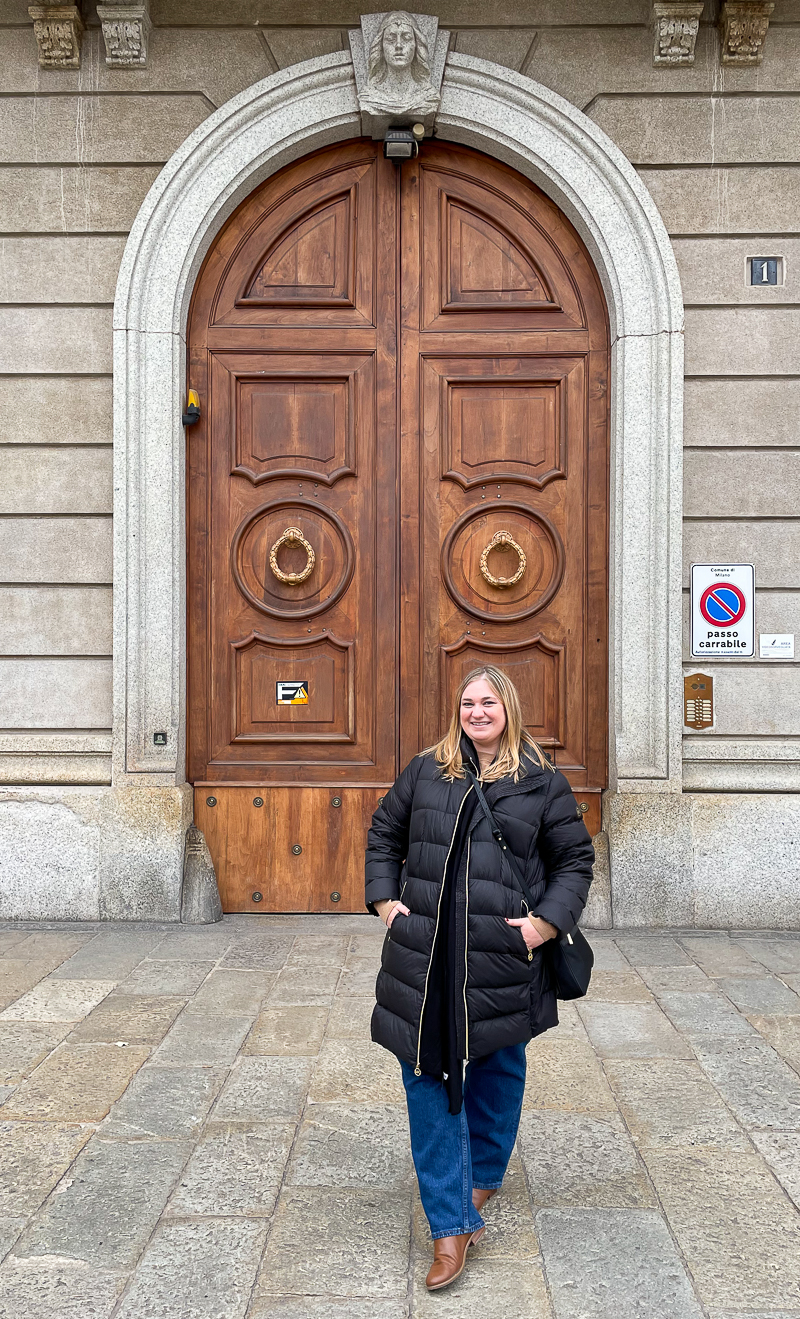
Finally, in the late fall through early spring, a packable puffer coat provides warmth, and a high-quality one should be water-resistant. I recommend selecting one that has a detachable hood, zippered pockets, and a length that hits near your knees. As long as your puffer coat is black or another dark and neutral color, you shouldn’t stick out too much as a tourist. 😉
I’ve traveled to Milan and Riga in chilly November and to Istanbul during a rainy March with this MICHAEL Michael Kors hooded puffer coat. I like that it packs down into a pouch for travel, and the water-resistant nylon material kept me dry in the rain. It’s lightweight enough to use in the damp and dreary weather of early spring and fall, but I layer warm clothing underneath and don a scarf, hat, and gloves with it in late fall.
Packing the Right Travel Essentials for Europe Makes a Difference
In conclusion, whether you’re a seasoned traveler or planning your first trip to Europe, having the right essentials can make all the difference.
Everything you pack, including clothing items and electronics, should serve a purpose and enhance your overall experience. But also remember to research the specific climate and activities of your European destination(s), and then tailor your packing list accordingly.
And if you’re still feeling overwhelmed by the thought of gathering all these necessary items, fear not! Visit my Amazon Storefront for a curated selection of Europe travel essentials to make your journey smoother and more enjoyable.
So don’t let a lack of essential items for European travel hold you back from fully embracing the adventure that awaits you there. Happy travels!
Read Related Articles
- Europe Packing Guide: How to Pack the Best Women’s Shoes to Wear in Europe in Summer
- What to Pack for the Beach: 30 Must-Have Beach Bag Essentials
- How to Enhance Your Food Travel with Airport Shuttles and Car Rentals
- How to Prepare for Studying Abroad in 15 Practical Steps
Save the pin below to your ‘Europe travel’ Pinterest board!

Photo Credit: Lead photo of packing a suitcase for vacation (© Pormezz/Adobe Stock)